
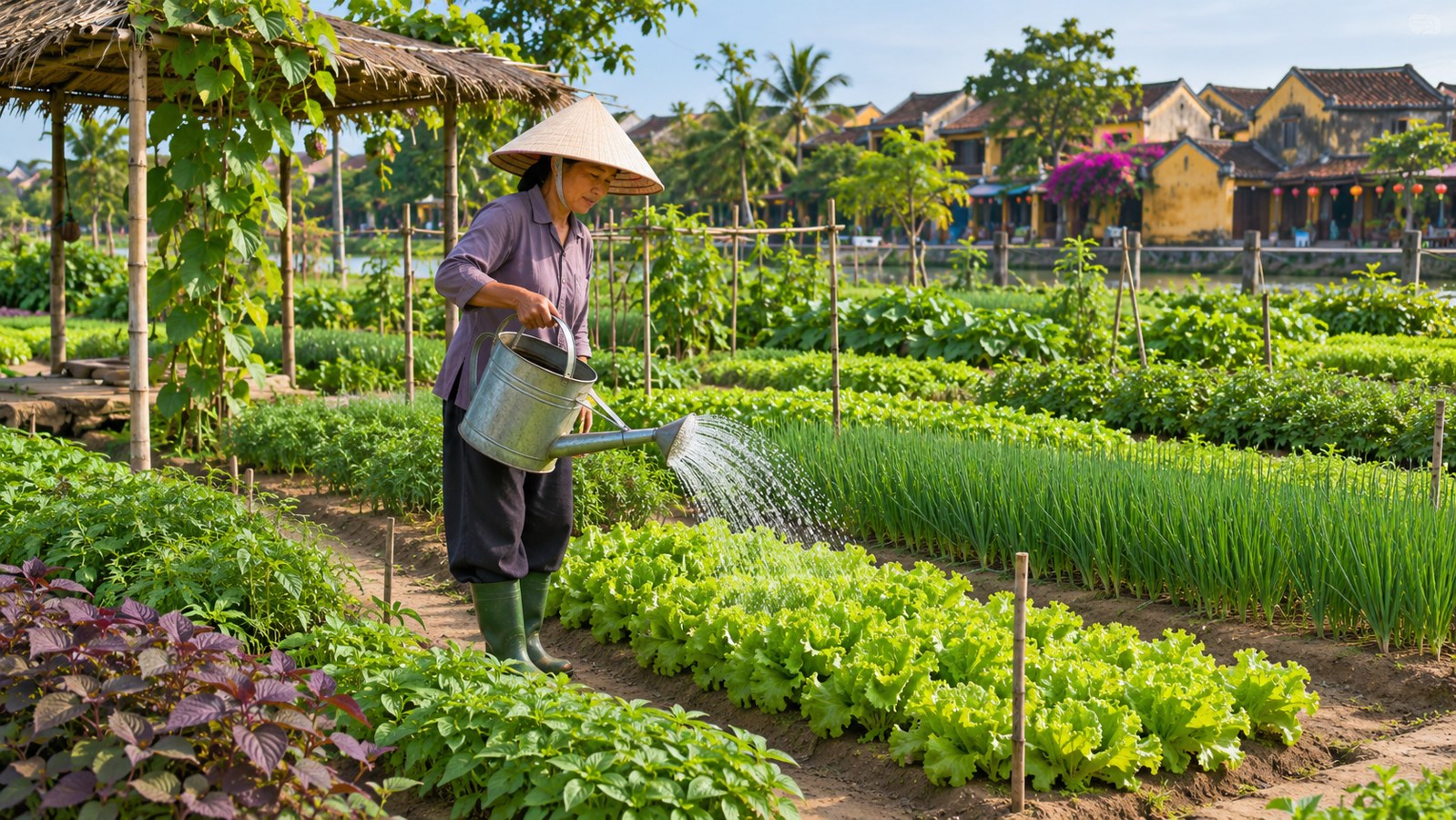
Trà Quế is a vegetable-growing village about three kilometres north of Hoi An Ancient Town. From Da Nang, plan a ride to a named garden, restaurant or activity host rather than leaving the driver to choose between village pins. A gentle walk and lunch make an easy outing. If you want to try gardening or prepare a meal, reserve that activity with a host and confirm what you will actually do. The beds are working plots, and independent visitors should ask which paths and areas they can use.
UN Tourism recognised Tra Que in its 2024 Best Tourism Villages programme. The agricultural tradition matters as much as the setting. Looking closely at the rows, the vegetation and the work taking place can make lunch in the area more interesting. If you plan to continue to Hoi An afterward, decide whether the village is the main visit or a shorter first stop. That choice will tell you how long to book a car, when to reserve lunch and which side of Hoi An you need to reach afterward.
Choose one way to visit
| What you want | Plan around | Confirm first |
|---|---|---|
| A quiet look at the village | A short visit on permitted paths near one known meeting point | Where to enter and whether the walk needs a ticket or a local host |
| A hands-on garden session | A named host, reservation and start time | Which tasks visitors may do, how long they take and what happens in rain |
| An unhurried garden lunch | A restaurant reservation and a small walk before or after | The kitchen hours, exact entrance, dietary options and transport |
| A cooking activity and lunch | A confirmed class with an ingredient or garden component | Who leads the activity, whether lunch is made by guests and what is included |
| A stop on the way to Hoi An | A one-way itinerary with a precise final destination | The time allowed at Tra Que and luggage arrangements |
Start by asking what your booking provides beyond access to the property. A guided farm visit, a demonstration and a hands-on work session can look similar in photos. One host may invite you to water a prepared bed. Another may give you a walk with explanations and leave farm work to the people tending the field. Both can be enjoyable. Choose based on what the group wants to learn and how much time it has, and get the actual activity stated on the confirmation.
A short walk before lunch can be enough if you mainly want to see the landscape and eat nearby. A family may value having one place to sit down soon after arriving, while keen cooks may want a longer visit to identify herbs and prepare a dish. Avoid buying every available add-on for an outing that already includes travel from Da Nang. People often enjoy the same place more when there is room to watch, ask questions and rest at their own pace.
Get to the correct meeting point
Use the Vietnamese name Làng rau Trà Quế along with the host's address. Ask whether cars can reach the entrance or should stop at a road junction. Gardens, eating places and activity hosts may be on lanes where a larger vehicle stops farther away. Find out who can direct you from that point. If the arrangement depends on a short walk across garden paths, check the distance and surface before you reserve.
A direct car from Da Nang suits travelers who want to go to Tra Que first and avoid an intermediate stop in Hoi An. Ask for a quote using your exact pickup, time onsite and final address. A separate return car can also work, provided the return point and time are confirmed. If you are already spending the day in Hoi An, it may make more sense to treat the village as a short outing from that base. For the broader intercity leg, see the Da Nang to Hoi An transport guide.
For an early visit, check when the host actually receives visitors. Morning is a sensible starting point if you prefer cooler conditions, but an early pickup has little value if the activities or restaurant are not ready. If your group wants to be back in Da Nang by a particular hour, work backward from that time. Include the return drive, the walk back to the pickup point and time to finish lunch. Protect the longest part of the visit and make the smaller extras optional.
Walk the gardens with the host's instructions
Start where a host or local sign says visitors should walk. A narrow line between beds may be useful for the people working there without being an appropriate visitor route. Avoid stepping onto planted ground, picking leaves or moving tools unless invited. When a garden worker is busy, look from a comfortable distance or ask the host when questions are welcome. Visitors can see much of interest without stopping the work they came to learn about.
Pay attention to the arrangement of the beds and the small differences between plants. From a path, see which plants sit in long rows, which have recently been tended and how water reaches the beds. Ask your host to identify one herb you have eaten and one you may not recognise. Comparing their scent or role in a meal gives the farming part of the visit a purpose. Vietnam's tourism information describes the area's tradition of vegetable growing and the local use of river vegetation in cultivation. A host can explain how their own plot is tended and how practices differ by crop or season.
For photographs, choose a spot where you do not block the footpath or private entrance. Ask before photographing somebody closely or before entering a plot to get a better angle. Keep children close near uneven surfaces and irrigation. If the group moves at different speeds, agree on a public waiting place rather than asking faster travelers to walk down narrow paths looking for others. A small route with useful explanations is often more rewarding than trying to cover the whole area.
Compare farming sessions and cooking activities
Ask how the visit is divided. A programme may start with a garden introduction, offer one or two tasks and then move to cooking. Another may spend most of the time at a kitchen and include a short walk to see ingredients. If the group likes the garden more than cooking, ask if a shorter lunch package still includes time with a host. If preparing food is the main purpose, find out whether each guest participates or several people share one station.
For a family, ask for the minimum age, whether children can do a shorter part and whether there is a shaded place for a companion to wait. Different tasks suit different interests. Watering or identifying herbs may be enough for a child who will lose interest partway through a longer cooking class. For older visitors, clarify whether they can sit during the explanation and join only the parts they want. Booking a shorter session with time for lunch can be preferable to committing everyone to the same programme.
Check what happens on days when weather affects garden work. A host might move part of the visit indoors, run a demonstration or offer a different time. Ask what would be included in that replacement. Someone who mainly wants lunch might be happy with an indoor explanation and a short break when conditions improve. Someone who wants outdoor work may prefer to reschedule. Agree on that before paying for an activity that cannot be changed. The Da Nang rainy-day guide is an option if you decide to keep the day closer to your hotel.
Arrange lunch around what you want to eat
Request a sample menu or a short description of the set lunch. If the appeal is eating with herbs you have just seen growing, ask which dishes are planned and whether the host explains their ingredients. Some activities include a prepared lunch. Others include a meal based on what guests learn to cook. Both are different from a reservation at a restaurant where you choose from a wider menu. Check whether drinks, extra dishes and a child's meal change the price.
Give the host any dietary requirements in advance and ask what substitutions are possible for your date. A description such as “vegetable village” does not indicate that the whole menu is vegetarian. The question is what will actually be served to the people in your group. If you prefer to choose dishes individually, consider an independent farm visit followed by an ordinary restaurant booking. If you want to understand how one dish is assembled, a class followed by the meal can be the focus of the visit.
Tell the driver when you estimate lunch will end, and agree on what to do if it runs longer. A set menu or class may need time between courses or activities. For a tight afternoon, choose a visit with a clear lunch window rather than trying to move the fixed pickup afterward. If you are staying in Hoi An for dinner, you might prefer a lighter lunch and a longer walk. If you are heading back to Da Nang after the village, a full meal can be a useful break before the return drive.
Decide how to continue to or from Hoi An
For a two-stop day from Da Nang, one practical pattern is a farm activity or walk followed by lunch and a late-afternoon visit to Hoi An. Keep the transfer to the Ancient Town as a separate leg in your timing. Share the name or entrance where the driver can legally drop you, rather than assuming cars can reach every pedestrian street. Decide where you will meet again before you enter the old town, especially if dinner or a separate outing changes where you finish.
If you want to bicycle from Hoi An, confirm the route, bike return and where you will park near the host. Pick a route and time suitable for your group. Do not assume a pleasant garden lane means the whole approach is equally quiet. If some guests prefer a car, agree on the same meeting point and a target time at the garden. Plan the return separately if the ride there already uses most of the time you have available.
For an accommodation change, give the driver your luggage details and final hotel entrance. Confirm who looks after the bags during the visit and keep essential belongings with you. A morning transfer with a garden stop makes sense when you can reach the next hotel comfortably afterward. If you plan another long excursion on the same day, compare how much usable time that leaves at Tra Que. The Da Nang and Hoi An itinerary can help you decide which day suits the village best.
Send one message before you book
“We are coming from [Da Nang hotel] on [date] and want [a garden walk/a farm visit/a cooking activity and lunch] for [group size and ages]. Please confirm the start and finish times, where the driver can drop us, what the price includes and what changes in rain. We would like lunch at about [time]. Please let us know the menu or available alternatives.”
Save the reply and the planned pickup. On the day, put the activity or meal you care most about first and use the remaining time to look at the gardens or continue toward Hoi An. A clear place to enter and a clear place to leave make it easier to enjoy what happens between them.


