
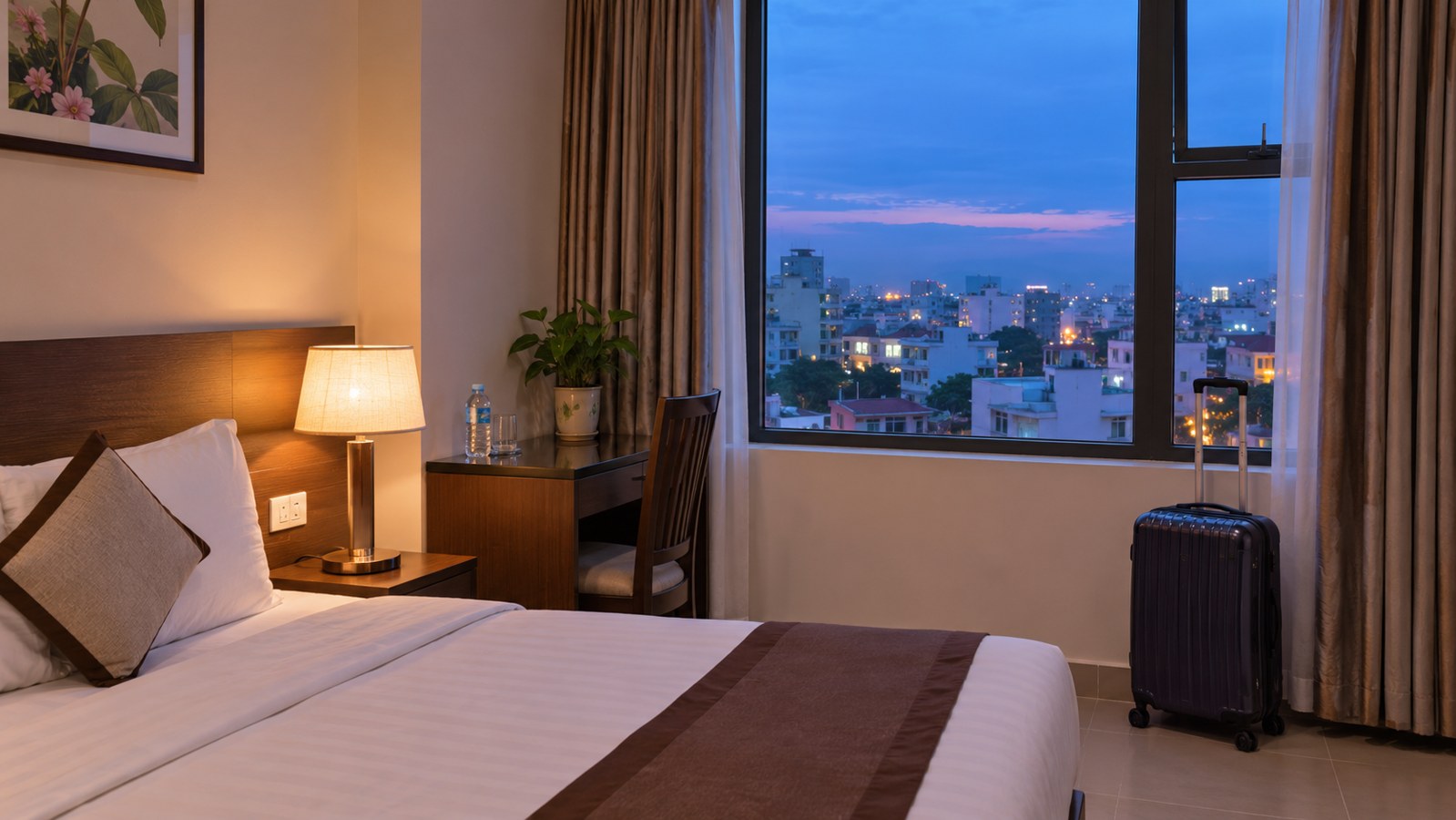
Book a hotel near Da Nang International Airport when it solves a specific problem: a departure before you would normally wake up, an arrival after midnight, or a connection that gives you one useful block of sleep. The useful comparison is the time from your room to the correct terminal, with a car you can actually get at your hour. A front desk that confirms an after-midnight arrival and gives you a clear place to meet your driver can be worth more than a hotel that appears a few streets closer on the map.
Start by checking which terminal your flight uses. Da Nang International Airport identifies T1 as the domestic terminal and T2 as the international terminal. Its departure guide places the check-in halls on the second floor of both terminals. For an onward flight, verify the terminal and check-in deadline with your airline and use the airport guide to confirm the layout. Set the airport destination using the terminal name rather than a saved generic airport pin.
Pick the kind of overnight stay you need
| Your situation | What to prioritize | What to check with the hotel |
|---|---|---|
| International flight early in the morning | Confirmed ride to T2, quick checkout and a room where you can sleep early | Pickup time, exact meeting point and a number to call if the car is late |
| Domestic departure at dawn | Confirmed ride to T1 and a simple room close to pickup | Whether you can settle any extras and return the key the evening before |
| Arrival after midnight | Written confirmation that the room will be held and someone can admit you | Which hotel night to book, latest arrival procedure and a contact you can reach |
| Overnight connection on separate tickets | Flexible booking and enough time to account for bags and recheck | Late-arrival policy, earliest pickup and cancellation terms |
| Last full evening in Da Nang | Dinner and a practical route to the airport next morning | Whether the transfer arrangement works from your preferred neighborhood |
Think in terms of doors you will actually pass through. For arrival, the sequence is terminal exit, pickup point, hotel entrance and room. For departure it is room, lobby, car, terminal drop-off and check-in hall. Mapping those steps takes a few minutes and makes it easier to identify where a short overnight stay could lose half an hour. Road distance alone skips the time you may spend waiting for a driver or calling someone to open the hotel entrance.
Search on the city side of the airport
Start with hotels on the airport side of the city center and look for pins around Duy Tan and Nguyen Van Linh. Use the streets as search areas, then inspect each property's position individually. A listing can mention the airport in its description while its entrance faces a different road from the one shown by a booking map. Copy the property name and street address into a map and request a driving route to your specific terminal. If the listing has an entrance photo, compare it with the position of the route endpoint.
For a very short stay, a small hotel with a staffed entrance and simple checkout can be all you need. If you still have a normal evening before your departure, a city-center hotel may give you a better dinner choice and a less rushed final afternoon. If you already have a room near My Khe, compare the cost of moving for your final night with the cost of booking a car from the same hotel. Changing rooms adds packing, a checkout, a transfer and a second check-in. For an adult traveler with one backpack, those steps might be minor. A family with a stroller, beach gear and several bags may prefer a single pickup from a familiar lobby.
An airport-area hotel is most valuable when it buys time you can actually use. For example, if two properties can arrange the same pickup time and the closer one only saves a small part of the ride, choose based on sleep and the front desk's response. If the city hotel cannot commit to a transfer but an airport-area hotel gives you a clear pickup plan, that difference matters even when both maps show a short route.
Plan an early departure backward from the terminal
Use your airline's check-in and boarding information to decide when you want to be at the terminal. If you have checked baggage, need document verification or are traveling with a group, account for those steps while setting your target. Then work backward through the drive, pickup and checkout. Treat a map estimate as one part of the calculation. Include time to get downstairs, load luggage and reach the right entrance at the airport.
A useful planning exercise is to write down four times: your target arrival at the terminal, your car pickup, the moment you need to be in the lobby, and the time you have to wake up. If the hotel responds with a different pickup time, compare it with your target rather than accepting it automatically. Hotel staff can help with the driving arrangement. Your airline remains the better source for its own deadlines.
Ask the hotel to confirm whether it is booking a car in advance or will request one when you come downstairs. Both arrangements can work when you have a buffer. A prearranged ride is easier to plan around when you have an unusually early departure or need a specific vehicle. If you're using a ride-hailing app, pin the correct entrance the night before and save the front desk number in case your driver has trouble finding you.
Before bed, put your passport, boarding information and payment method in the same accessible pouch. Pack most of your luggage while the room is well lit and you are fully awake. If breakfast is included, check when it starts before adding it to your plans. For an early ride, ask whether a takeaway option exists and whether it has to be requested the evening before. Otherwise, budget for breakfast after you reach the terminal or pack something you can carry.
Book the correct hotel night for a late landing
A flight arriving at 12:40 a.m. on Tuesday usually means you want a room reserved for Monday night if you plan to go straight to sleep. In that example, a Tuesday reservation generally starts during Tuesday's check-in period. The hotel's own confirmation controls your specific booking, so state the calendar dates plainly. Tell them your booking starts Monday and your flight is scheduled to land at 12:40 a.m. Tuesday. Ask how to enter if your actual room arrival is an hour or two after landing.
The gap between touchdown and your arrival at the hotel is especially important for an international flight. You still need to leave the aircraft, complete the relevant arrivals procedures, collect checked bags if you have them and find your ride. Avoid giving the front desk a hotel arrival promise based only on the flight's scheduled landing time. Send your flight number and a realistic arrival window, and ask how the hotel handles a delay.
Look for a reply that answers practical questions: whether the room stays assigned, whether staff are available, and which entrance you should use. Save a screenshot of the answer and the booking confirmation. If front-desk hours are limited, ask whether you need a door code or a call on arrival. Check that you will have a working phone number or data connection by the time you leave the terminal. A listing that says “24-hour reception” can be a good starting filter. Written instructions for your booking give you something concrete to follow.
Compare the total overnight cost
For a one-night airport stay, compare the price you will actually pay. Start with the room including taxes and mandatory fees, then add the airport ride and anything you need to use the room at the intended time. For a late arrival, that might include a late check-in fee if a property has one. For an early departure, include a ride large enough for your group and bags. A couple with two backpacks and a family with three hard-shell cases may need different vehicles even when the pickup distance is identical.
When comparing transfers, ask whether the quote is per car or per person, one way or round trip, and whether anything changes at your arrival hour. If the hotel quotes a pickup with a wait limit, ask when the clock starts and how the driver tracks delays. Save the amount and expected payment method alongside the pickup details. That keeps the comparison practical when your alternative is a car ordered after arrival and the app fare may vary.
Also consider how much flexibility you need. If an inbound itinerary frequently changes or you are holding separate tickets, compare a flexible rate and a prepaid rate with a cancellation deadline. Read the cancellation deadline in its stated time zone and check the no-show terms separately. Being able to cancel before check-in and being allowed to arrive after midnight are two different questions for the reservation.
Choose a room you can sleep in
For this stay, room position is more relevant than most amenities. Ask whether a quieter room is available away from lifts, street traffic or the breakfast setup. If you need an early bedtime, request a room with effective curtains and ask about any renovation affecting the room type you're considering. A quiet room category is more useful than a vague request if a property can identify the specific side of the building. A traveler with a heavy suitcase should also check whether there is lift access from the entrance to the room.
For families, specify the ages of children and the number of adults on the booking. A standard room shown for two guests might have different rules for a young child sharing bedding, an extra bed or a cot. Ask the hotel to confirm bedding and occupancy together. If you are landing after midnight, request that any extra bed or cot be set up before arrival so the room is ready when you collect the key.
Think about what you need immediately after arriving. If dinner service is likely to end before you reach the hotel, have a plan for water and a snack. If one traveler needs to sleep while another repacks for the morning, ask whether the room layout has a practical place to open a suitcase. Neither issue is obvious in a search result, but both can change how much rest a short stay delivers.
Check whether walking is practical
Use walking directions from the hotel entrance all the way to the terminal you will use, rather than drawing a straight line to the airport boundary. Consider pavement quality, crossings, lighting, weather, luggage and whether you will be walking alone. If you are deciding based on the map, inspect the whole route. A line that stops at the edge of an airport road or changes to an unmarked path is a reason to ask the hotel how guests normally get to the passenger entrance.
For an early flight, compare the walking plan with a short booked car ride. A car is easier to budget when you have children, heavy bags or rain. If you choose to walk, save the route offline, name a point where you can switch to a ride if needed and leave time for that switch. A hotel may be very handy for a daytime walk and less appealing for the same trip before sunrise.
Spend an overnight connection outside the airport only if it gives you usable sleep
Write down the time you expect to clear arrivals and the time you need to be back at the next check-in hall. Subtract the trips in both directions and hotel check-in and checkout. The time left is the potential sleep window. If that window is useful, a nearby room may be worth booking. If it is very short, a room farther away with extra amenities will be difficult to enjoy.
For an international-to-domestic connection, the airport's transfer guide describes completing arrival formalities and baggage retrieval before continuing to the domestic terminal. Use the airline's instructions for your individual itinerary, especially when the flights are on separate bookings. If one flight is moved, recheck the accommodation date and pickup details as part of the same change. A booking confirmation stored offline is useful if your mobile data is unavailable when you arrive.
Send one message that covers the handoff
For a late arrival, try: “My booking is for the night of {date}. Flight {number} is scheduled to land at {time} on {date}. I expect to reach the hotel between {times}. Please confirm the room will be held and tell me which entrance to use if I arrive after midnight.”
For a departure, try: “My flight departs from Da Nang Airport {T1/T2}. I would like to arrive at the terminal by {time}. Can you arrange a car for {number} passengers and {number} bags? Please confirm pickup time, price, meeting point and a number to call if the car is late.”
Save the reply and check that it names the same hotel and street as your reservation. If you ask a second property for a quote, compare the replies with the same room date, terminal and passenger count. This is particularly helpful when one property offers an airport transfer as part of its rate and the other charges separately.
Booking checklist
- Select the hotel night that covers when you need the room.
- Check the airline's terminal and check-in instructions for your actual flight.
- Save the hotel entrance, phone number and booking confirmation offline.
- Confirm reception access for a late landing or checkout arrangements for an early departure.
- Check the room's occupancy, bedding and lift access where relevant.
- Set the terminal arrival target and arrange pickup for the full group and luggage.
- Compare the whole overnight cost, including transport and any fees you expect.
- Recheck the arrangements if your flight date or time changes.
If the airport is simply your first stop on a longer visit, read the Da Nang airport-to-city guide for transfer planning and Where to Stay in Da Nang for the neighborhoods that suit the rest of your trip.


