
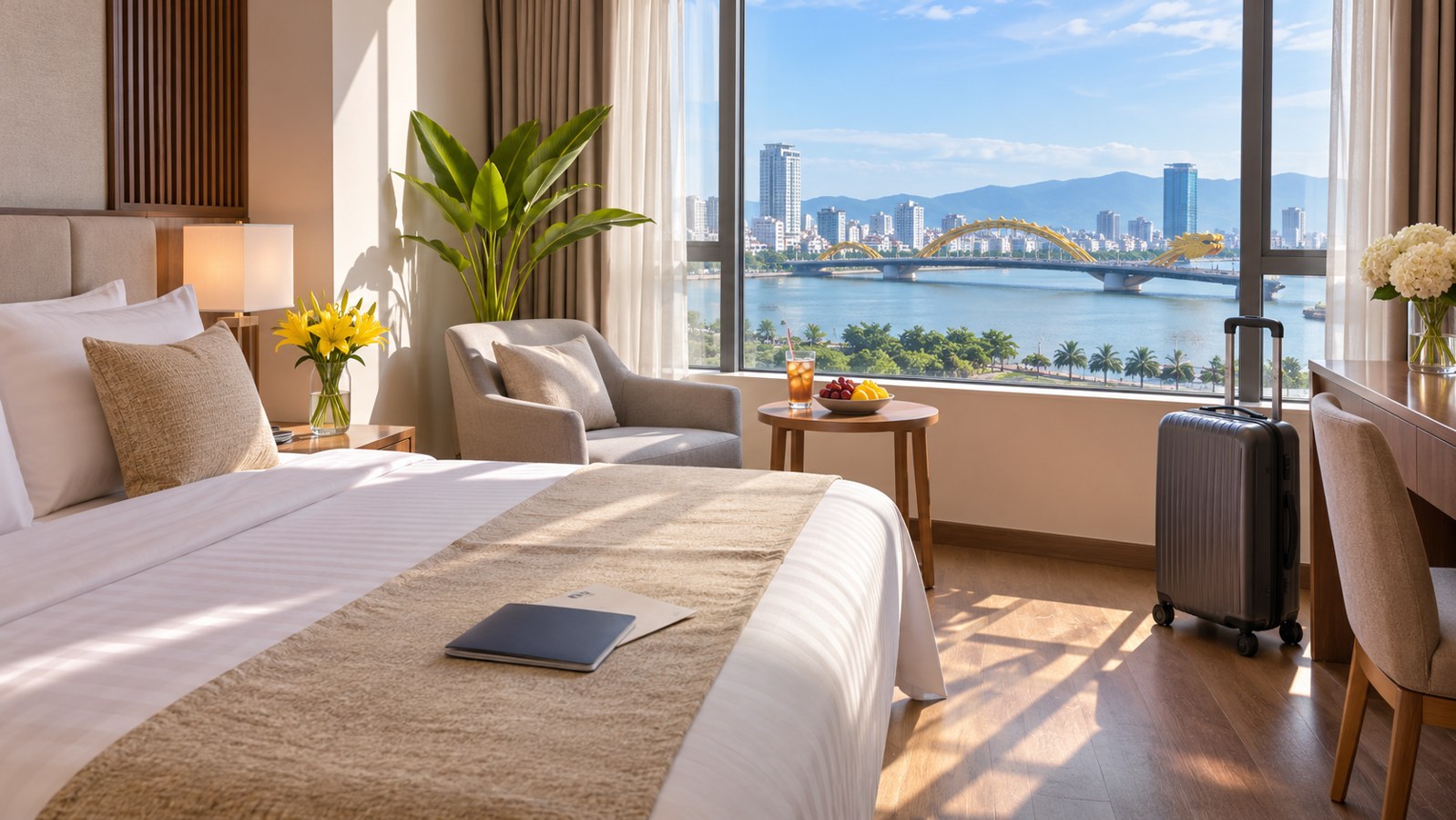
A day-use hotel room in Da Nang gives you a place to rest, shower and repack during a defined daytime block. It can work between flights, after a red-eye arrival or when your room checkout is much earlier than your evening departure. Start with the hours you can actually spend in the room. Once you have set aside time for baggage, both transfers and your onward flight, you may have several quiet hours to use. A short connection may leave too little time to leave the terminal area comfortably.
Search the term day use together with your date, then read the exact room name and access conditions. For example, a booking listing for Oasis Hotel & Apartment has advertised a Family Studio with four hours of day use and a same-day operating window. It is a lead to check for a date and rate, since hours and room options can change. For a gap after an overnight stay, ask your current property about keeping the same room before looking for a different one. A confirmed extension can save the work of moving people and bags twice.
Choose the right short-stay arrangement
| Situation | Option to check first | What makes it useful |
|---|---|---|
| Several open hours between flights | A day-use room near the airport or in central Da Nang | A confirmed time block and a clear return ride to the correct terminal |
| Evening flight after a city or beach checkout | A confirmed late checkout at your current hotel | Keep the same room and avoid moving your luggage across town |
| Early arrival before the hotel's regular check-in | Booked early access or a paid daytime block | The room is available when you arrive rather than after scheduling changes at reception |
| Late flight with only a short gap | Luggage storage plus a nearby meal or activity | Fewer transfers and an easier departure plan |
| Room needed from one calendar day into the next | An overnight reservation with the correct arrival date | Keeps the room available across midnight and suits a longer rest |
Ask the hotel to state the arrival date, start time, end time and room type on the booking. Some daytime listings show a broad period in which a fixed-length booking can take place. That is different from having the room for the entire period. A four-hour use between 13:00 and 22:00 could require choosing a specific start time. Find out whether the property holds the room from the reservation start or allows the clock to begin at check-in. If a flight arrives late, those two policies can give you very different usable time.
Calculate the room time from your flight plan
Set your target arrival time at the terminal for the onward flight using your airline's instructions. Allow for its check-in and baggage deadlines, document checks that apply to your trip and the walk inside the terminal. Then work backward to the room checkout and the time you need to be ready for pickup. For a flight into Da Nang earlier that day, make a separate estimate for how long it will take to leave the arriving terminal, collect bags where necessary and reach the hotel.
Here is an example for planning, with times to replace for your own booking. Imagine your flight arrives in the morning, you estimate that you can leave the terminal at 11:30, and you want to return by 17:30. That gives you six hours from terminal departure to target terminal return. If you allow 35 minutes for each direction and another 30 minutes across hotel arrival and departure, at most four hours and 20 minutes remain. With a four-hour block, there is little spare time for the flight arriving late or a ride taking longer than planned. A three-hour block or a hotel with flexible admission could give a more useful margin.
For a connection, verify that you may leave and return under the conditions of your itinerary. When you are arriving internationally or using separate tickets, check entry, onward check-in and baggage arrangements before paying for a room outside the airport. The fact that the first flight lands at a particular hour is only a starting point for your calculation. If you are unsure about your specific connection, confirm it with the airline or operator responsible for the booking. Give first priority to the onward ticket and choose the room after you know what time you can safely spend away.
Write the plan as four events: when you can leave the airport, when the room is available, when the car must pick you up, and when you want to be at the terminal. Da Nang's domestic and international flights use different terminals. Confirm which one your onward flight uses and name it when arranging the return. If you want to buy food or run an errand on the way, schedule that along the same route and allow enough time that it can be skipped if you are delayed.
Pick a neighborhood based on the use of the room
A hotel on the airport side of central Da Nang suits a shower, quiet rest or work session when time is limited. Start with the exact property entrance and compare the map route to your terminal. A room deeper in a neighborhood may be nearby in distance but less easy for a driver to reach. Ask where a car stops and whether the hotel can give you a readable Vietnamese address. An arranged pickup can be useful if you must return at a specific hour and have several bags.
A riverside or central room is worth considering for a longer gap if you want a meal and a walk. Before booking, decide whether the meal is part of the room time or a separate stop. If you want only a short shower and change after lunch, a small room block may be enough when it begins at the right hour. Compare that plan with keeping bags at your existing hotel and returning directly from a meal. The room should solve something specific, such as giving you a quiet place to rest or use a bathroom before the flight.
A room near My Khe can suit a long gap that includes the beach or a relaxed meal. It adds a cross-city leg for most airport trips, so compare the desired beach time with the return margin. If you are already staying there, an extension at your hotel may be easier than going inland for another room. For a tighter schedule, spending part of the day near the airport or train station may leave more time to rest. The locations are useful for different reasons, so choose the starting point that fits your actual movements.
Ask your current hotel before moving to a day room
Tell reception exactly when you want to leave rather than asking only for “late checkout.” If you need the room until 16:00, ask for a confirmed extension to that time and a total price. If the current room is booked for another guest, check whether the hotel can offer a different room on the same property. You may still need to pack and change rooms, but leaving luggage at reception while you wait can make the transition easier than traveling to a second hotel.
When staff can offer only a short extension, compare it with your actual plans. An extra hour may be enough to shower and repack before lunch, even if you do not leave for the airport until later. Ask separately about luggage storage and where you may wait once you have checked out. Verify what access remains to facilities after checkout. A property that agrees to hold bags may have different terms for using its pool or showers. Decide whether you need a room for the full gap or just a shorter period with independent plans before and after.
Ask whether the extension belongs to your original reservation or is a separate paid arrangement. That matters for payment, recording the checkout time and getting back into the room after the normal cutoff. Confirm the room key continues to work and tell the desk if you will leave the building for lunch. A room extension that has been communicated clearly to reception and housekeeping is more useful than a verbal suggestion that you can probably stay.
Check the fine print on day-use listings
Make sure the reservation is the right type. A low price might apply to only a specific number of hours or a room in a given time window. A nightly listing may have a standard afternoon check-in even when it appears in a general search for daytime stays. Choose the named day-use offer, check whether in-person payment or a deposit is required and confirm that the rate is for the correct occupancy. If several people want to use the room in shifts, ask whether everyone needs to register and what visitor rules apply.
Read the physical room details if rest is important. A room with a window or quiet location may be worth more than a small discount. If you need to take a work call, ask about a desk and the ability to access the room without delay. If you want to shower, verify that the booking comes with a private bathroom and towels. The room you actually need for four hours may be different from the room you would choose for a week. The booking should say what you are getting and when you may use it.
Check what happens if you arrive after the agreed start or need to leave earlier. Some properties sell a fixed window regardless of when you check in. Others may accept a later arrival within their operating hours. Ask when a booking is considered a no-show and whom to contact on the day. Do not commit to a block that relies on a connection working perfectly if its terms offer no flexibility. In that situation, a property willing to quote on arrival, luggage storage or a shorter plan may be easier to manage.
Plan for luggage and onward transport
Estimate the size of the vehicle with all luggage, not just the number of people. An extra bag can make a standard car impractical when the group is moving between the terminal and hotel twice on the same day. Confirm where you will meet the driver and whether the exact hotel entrance is reachable. Save the booking and hotel address offline. For an outbound leg, tell the driver the terminal as well as the airport name, and leave your room early enough to get everyone and all bags down to the vehicle.
If you plan to leave luggage in the room while going out, confirm the booking end time and what happens if you are away when access ends. For an earlier checkout, ask whether reception can hold your bags after the stay and where to collect them. Save the claim ticket or message before you leave. If you will need a change of clothes or charger, keep those in a small bag so you do not have to unpack the entire suitcase. The plan should preserve some usable rest time after the bag handling, rather than filling the short stay with logistics.
When you book a return pickup, choose a time before the room ends if the checkout desk could be busy. If the room rate includes a deposit, ask how it will be refunded and how long checkout usually takes. Verify whether a special late pickup or oversized vehicle has a surcharge before accepting the offer. Price both transfers when comparing hotel options. A very cheap short stay at the wrong end of town can cost more once you add two rides and lose time inside the room.
Send a date-and-time request
“We need a day-use room on [local date] for [number of guests], from [start] to [end]. Is a room with a private shower available for that exact block? Please confirm when the room will be ready, the total price and what happens if our arrival is delayed. We will have [luggage]. Can you help arrange a pickup to [domestic or international terminal] at [time]?”
A useful answer gives you a full start and end time, an address and a total price. Save it with your flight booking and check both confirmations on the day. If the hotel cannot commit to the interval, compare a later start with one of the alternatives. Between flights, an available room close enough to use is more valuable than a nicer one that removes your margin for the return. After a regular stay, keeping the same room for longer can be a better use of the same budget.
For transfer planning, see the Da Nang airport-to-city guide. For early departures and arrivals that require sleeping overnight, read the guide to hotels near Da Nang Airport.


