
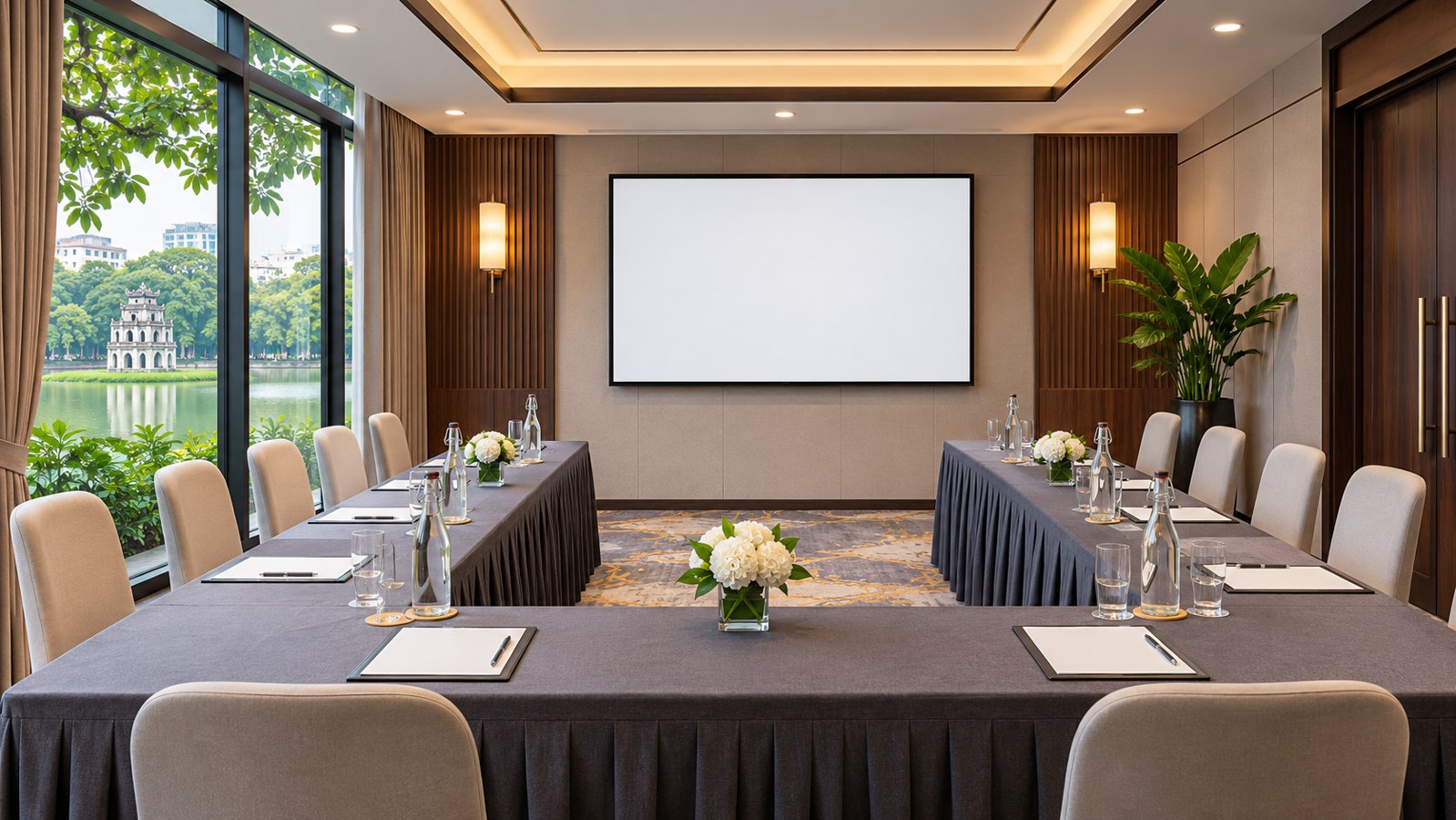
Start with the room layout and the work your group needs to do. For a board meeting, look for one table where everyone can see the screen and hear each other. For training, allow space for laptops, an instructor and movement between seats. Three useful places to ask are Hilton Garden Inn Da Nang on the beach side, Novotel Danang Premier Han River in the central river area, and Grand Mercure Danang for flexible rooms and a half-day or full-day quote. Confirm the named room and setup before booking guest rooms around it.
Published hotel capacities describe what a venue can hold under certain conditions. A maximum in theater style says little about whether the same room can accommodate a group working in pairs with desks and power for everyone. Give the events team a draft agenda, the number of seated participants and the layout you want. Ask them to include the instructor, interpreter or support staff when they check space and equipment.
A shortlist for small meetings
| Property | Useful published detail | Ask the venue |
|---|---|---|
| Hilton Garden Inn Da Nang | Its events page lists a 34-square-meter Board Room and a capacity of 12 in the conference configuration | Whether the named room has enough table space and audiovisual capacity for your group |
| Novotel Danang Premier Han River | It publishes several meeting rooms and a banquet brochure that lists Moc Son and Tho Son among its smaller spaces | Which room works in your chosen layout and what support is available for slides or remote participants |
| Grand Mercure Danang | Its venue information describes flexible meeting spaces, audiovisual services and half-day or full-day packages | The exact room or partition, the break setup and what equipment is included in your quote |
These descriptions make it easier to frame an enquiry, but availability, setup and terms need a dated confirmation. If the venue proposes a different room, ask for an updated floor plan, capacity and quote. A larger replacement can be a good option if it preserves the group layout and service. The room name matters when you need to plan a specific camera position, breakout setup or an accessible route that differs between floors.
Choose the layout before asking for a price
For a board meeting, use a table that lets every person speak and see the participants on the other side. Check where the display is relative to the table and whether one long edge needs to be turned toward it. A fixed table may work well for discussion but leave people looking sideways at slides all afternoon. When remote attendees join, ask whether the camera can see each seat and whether the microphone will pick up quieter speakers at the corners.
For a workshop, compare a U-shape with small group tables. A U-shape can give the facilitator room to move and let people face each other. Separate tables can be easier for team exercises while making whole-group discussion less direct. A classroom setup may suit individual laptop work, but participants may need to turn around for group exercises. Give the venue a realistic description of the activity and ask for a photo of the room in a comparable setup.
Include equipment and extra space in the capacity request. If each participant needs a laptop, papers and water, the table can fill before the room reaches its advertised capacity. If a camera, stand or recording desk will occupy part of the floor, reserve that space on the layout. Ask where people enter, where bags can go and whether someone can leave briefly without walking through the presentation area. A room with a sensible path for people and equipment is easier to use than one that just meets a seat count.
Plan the first twenty minutes
Write the plan for arrival and opening. People should know which entrance to use, who registers them and how to find the meeting floor. If some attendees arrive directly from the airport, find out whether they can leave bags before their guest rooms are ready. For a local group, ask where drivers can stop, where attendees can park and whether reception can direct them without an organiser in the lobby.
Ask when your team can enter to set up, separately from the start time in the room quote. You might need to test a presentation, connect a laptop, arrange materials and check the video call. If the quote begins at the same time as the welcome, ask to amend the access window. Find out when staff are available and how to reach them without leaving the room. If the event starts early, verify the arrival hour for that support as well as the room itself.
For a group with translated material or an interpreter, plan where that person will sit and whether they need a separate microphone or monitor. If people will fill out forms or connect to an internal system, send the necessary instructions before the meeting and bring a copy you can use offline. A hotel can provide the room and connectivity while your team still needs a way to get attendees started if Wi-Fi logins or software access take longer than expected.
Ask about the exact AV and hybrid setup
Find out whether the quote includes a screen, a projector or a large display, and whether your laptop can connect to it. Ask about adapters, cable lengths and where the presentation computer will sit. If someone will move around while speaking, determine whether a supplied microphone is handheld, clip-on or built into the room. For a small discussion, a room microphone may be more useful than a loudspeaker system designed for one presenter at the front.
For a hybrid meeting, test the end-to-end experience from the perspective of a remote attendee. Can they see the participants, hear questions and read whatever is shared? Ask whether the hotel's equipment includes a camera and a speakerphone or whether they only provide a display and general room sound. Confirm the network arrangements for the video call and for participants using their own devices. If the session is important, arrange a test from the actual room with your device and call platform before the first participant arrives.
Plan a fallback for problems with the room equipment. Keep the deck on the presentation computer and have a copy available to the organiser. Decide who can run the meeting temporarily if the presenter is troubleshooting. Ask if a spare cable or an alternate presentation device is available. If independent Wi-Fi access or dedicated technical support is on the quote, check the operating hours and whether the technician stays in the room or helps only during setup. These details can change how much time you should reserve.
Compare half-day and full-day packages fairly
Request the whole meeting price for the same headcount and schedule. A per-person package may include the room, water and a break, while another quote prices these separately. Check for a minimum guest count, any minimum spend and charges for early setup or late departure. Ask what amount is due if fewer people attend than the number you booked. Confirm whether mandatory service charges and taxes are reflected in the number you are comparing.
For a half-day meeting, decide whether you need one break and a meal or simply a short refreshment window. Check the time that service is available and whether food can be set up outside the room. If you have a working lunch, confirm that staff can serve it without undermining the meeting schedule or putting people at tables that do not suit the next activity. For a full-day booking, ask whether the room remains available during lunch and whether you may leave papers and equipment there.
Compare per-person and room-only quotes using actual quantities. For example, a room-only rate might appear cheaper until you add two hours of technical support, a display, food and the same setup window that the package already includes. Alternatively, an inclusive rate may add breakfast or lunch most of your local attendees will not use. Ask for itemized figures so you can assess the differences without treating unused benefits as savings. If a group dinner is part of the event, request it separately enough that you can see what it costs.
Pick an area that supports the group's travel
For participants traveling independently to Da Nang, compare an area near the meeting site with the routines before and after it. A central river hotel can work when the schedule includes downtown meals or attendees are staying at several nearby properties. A beach-side venue can be attractive for a retreat with time after the meeting and a shared evening plan. The guide to where to stay in Da Nang can help you compare these bases for the rest of the trip.
If local attendees and overnight guests are both attending, check the vehicle approach from each side. A room next to guest accommodation is convenient for overnight visitors but can be awkward for a local attendee who has nowhere to park or has to enter from another street. Provide one named drop-off point and an alternate route where useful. For airport arrivals, share the Vietnamese address and the event name rather than only the hotel brand. See the Da Nang airport-to-city guide when estimating arrivals.
Think about the end of the day as well. People heading directly for a flight may leave at different times from those staying for dinner. Ask about luggage access and where their car can wait without blocking other attendees. Consider scheduling the last essential decision before the first group needs to depart. If you are moving everyone to a separate venue for dinner, verify whether the transfer price includes both directions and allow enough time to collect people from the hotel lobby.
Handle guest rooms as a related booking
Ask whether the meeting is conditional on buying bedrooms and whether the room block has a cutoff. Some attendees may want to book on their own or arrive a day earlier. Check which nights the group rate applies and whether the event terms depend on the number of occupied rooms. A participant should know whether they use an individual reservation or appear on a rooming list controlled by the organiser. Clarify who pays for extra nights, breakfast and any incidental items.
Request a setup plan and a separate list of bedroom terms. Meeting catering guarantees and hotel room cancellation rules can have different deadlines. Record the exact time and local date for changes, especially when the organiser is working from another country. If a group uses several room types, ask about check-in for early arrivals and who can confirm room assignments. A central group contact at the property can help connect separate teams responsible for events and accommodation.
For a small team that does not need a group rate, it may be simpler to book the meeting with the venue and let participants handle bedrooms. Compare the cost with a negotiated block before deciding. If you accept a block, report attendee changes on the schedule agreed with the hotel so both sides use the same headcount. This is particularly important when weekday attendance is uncertain and the same reservation is being used for catering, room setup and bedrooms.
Send a brief the venue can quote
“We need a room for [number] seated participants plus [facilitators and support staff] on [date]. The meeting runs [times] and setup starts [time]. We want [layout], space for [laptops or materials], and [AV or hybrid requirements]. Please name the room, confirm capacity in that layout, and quote the total with [number and timing of breaks, lunch and any bedrooms]. Please also state access, cancellation and final headcount deadlines.”
Compare responses based on the same brief. Save the room name, photos or layout, inclusions, price and schedule in one place. When the offer is confirmed, send participants the entrance, floor and arrival instructions. The most useful room for a small group is the one that supports the work, gives everyone a clear place to sit or connect, and makes the day easy to start and finish.


