
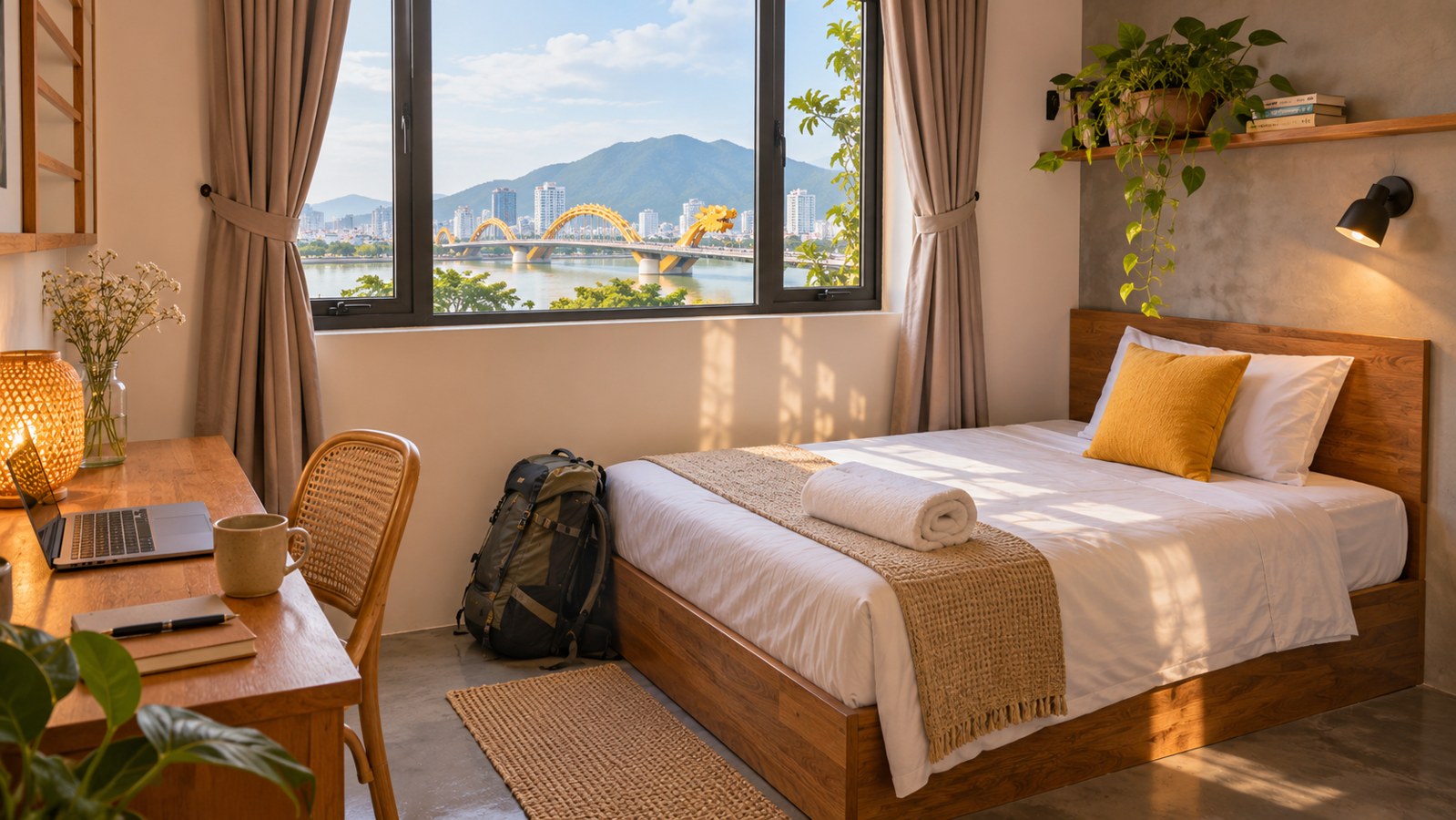
A private hostel room makes sense when you want a bedroom to yourself and the option of meeting people in a common space. Start by comparing a beach-side property such as The Memory Danang Boutique with a more central option such as Seahorse Natalie Da Nang by Sujet of Haviland or Seahorse Signature Da Nang by Sujet of Haviland. Hostel booking listings include these among the city's private-room options. Check the property and room category for your dates. A private bedroom may still have a shared bathroom, and a property with private rooms may operate more like a small hotel than a social hostel.
Choose the neighborhood around something you can easily do on your own. Near the beach, an uncomplicated first morning might be coffee and a walk by the sea. In the center, it could be breakfast, the market streets and the river. A hostel's common room can add another option, but the trip should still work when there is no event or nobody is sitting downstairs. For the larger neighborhood decision, see Where to Stay in Da Nang.
Compare a few room leads
| Property to look up | Why it is on the shortlist | Detail to check |
|---|---|---|
| The Memory Danang Boutique | Hostel listings show private rooms as well as dorm options, useful for a beach-side shortlist | Whether the room has an ensuite, an exterior window and access to a common area |
| Seahorse Natalie Da Nang by Sujet of Haviland | Listed with private options and useful for a central-city comparison | Exact branch and entrance, check-in arrangements and whether any current social activity is open to private-room guests |
| Seahorse Signature Da Nang by Sujet of Haviland | Listed among central private-room choices | Room category, bathroom arrangement and how the room relates to any shared areas |
| The Garden Capsule Hotel | Private options appear in hostel listings for the property | Whether the offer is a fully enclosed private room or a capsule with shared facilities |
Use names and addresses together. Seahorse has multiple properties, so a review or a photo can refer to another lobby. The brand's property information has listed Seahorse Natalie on Yen Bai Street and a separate Han Market location on Nguyen Thai Hoc Street. Check your reservation pin instead of choosing a destination by typing the brand alone. This is especially useful if you take a car from the airport after reception hours at another branch.
Hotel and hostel labels can also change between booking channels. Look at how the exact property operates now. Some welcoming boutique hotels have quiet shared seating but no organised events. Some small hostels organise meetups without a large common area. A lobby does not need to be busy for the property to suit you, but if meeting others is the main reason for choosing it, ask what guests currently do together and where.
Confirm what the word private covers
Read the room description for three separate things: who can enter the sleeping area, who can use the bathroom and what common facilities come with the room. A single or double room reserved for one traveler can give exclusive access to the room. A bed in a pod may have a curtain or a sliding panel but still share the surrounding sleeping area. A private room with a shared bathroom gives you a door to close and a bathroom you may have to wait for. Decide which arrangement you can use comfortably for multiple mornings.
Bathroom terminology is worth checking. An ensuite generally means the bathroom opens directly from the bedroom and is for that room's occupants. A private external bathroom may be assigned to the room while accessible from the corridor. A shared bathroom is used by other guests. If the listing only describes the property as having private bathrooms, find out whether that applies to your category. Ask where the bathroom is and whether there is a shower if you plan early starts or expect to return late.
Look at natural light, ventilation and luggage space after choosing the bathroom arrangement. Some lower-cost private rooms may have a window opening to a corridor or an interior shaft, while others have an outside view. A photograph taken with the lights on may make it difficult to distinguish the two. If you expect to spend part of the day working, ask for a picture of the room in daylight and check whether you can sit at a real desk. For sleeping and showering between outings, a simpler space can work if the bed and air conditioning meet your needs.
Choose a neighborhood using two everyday routes
The first route is from the property to your usual breakfast or coffee. The second is from the place you are likely to finish the evening back to the property. Read both directions and look for the entrance you will use. On the beach side, a room on a quieter side street can work well if it has a clear path to food and to the coast. Compare the route to the shore separately from the room. A main road can make a short map distance less convenient than it looks.
Near the river or market streets, test how you would get from dinner to the building. The riverside can make it easy to start an evening walk, while a room on a main street may experience more activity later in the day. Decide whether a short walk back or a quiet sleeping setup is more important to you. If you want both, ask for a room away from the outdoor seating or busiest side of the building. You can use the Da Nang at night guide to plan the evening independently of the hostel.
Think about the rest of the itinerary as well. A centrally located room may make airport or train connections simpler for a brief stop, depending on your transport plan. For a longer trip, choose the neighborhood you'll be happy to repeat on a day with no big excursion. Coffee, laundry, dinner and a place to read occupy more time than many travelers expect. A reasonably priced hostel that meets those routine needs can give you a better stay than one with more amenities far from your plans.
Check how social the stay will actually be
Ask whether private-room guests may use the same lounge, kitchen, terrace or activities as dorm guests. Some hostels include everyone, while a property operating more like a hotel may have a small lobby and few shared activities. Look for recent comments describing how people met. A group walking tour, weekly meal or common table gives you more information than a generic description of a friendly atmosphere. Confirm any event that matters to your trip before counting on it.
For an introverted traveler, informal seating may be preferable to a fixed social schedule. A quiet lounge where guests come and go offers a low-pressure way to meet people while keeping your evenings free. If you deliberately want a lively property, ask when the common area usually winds down and which rooms are separated from it. This is particularly useful if you want a social evening one night and an early tour the next. Room placement can determine whether the same property works for both plans.
You can also choose an ordinary small hotel and meet people through a specific class or outing. Compare that with a private hostel room at a similar rate. If you expect to spend most of your time outside, the choice may come down to bathroom, sleep and location. If you want the option of casual conversations between outings, access to a usable common space earns its place in the comparison. There is little benefit in paying extra for a more social listing if its activities do not overlap your dates.
Compare real prices for one guest
Enter one traveler across all the searches you are comparing. A price shown for a dorm may be per bed, while a private listing may charge for the whole room. Use the final nightly cost plus any taxes or service charges that appear at checkout. If a private room has space for two but no single-occupancy discount, compare it with a normal budget hotel on the same street. For a short stay, a small difference may be worthwhile for a private shower or flexible arrival.
Check what the private rate includes. Breakfast, towels and luggage storage can differ between properties or even between room categories. If you'll leave before breakfast, compare the price without counting the meal as a savings. If you need to store a bag most of the day after checkout, ask what hours the property will hold it and how you collect it. For two or three nights, these seemingly small conditions can matter more than a discount attached to a prepaid room.
For a longer solo trip, ask how often the property services the room and whether there are additional charges for a linen change. Long rate periods can cover room use without including the same services you would get every day in a hotel. Read cancellation conditions before paying for every night. A traveler whose route depends on a train or a weather-sensitive excursion may prefer to confirm a shorter stay and ask if it can be extended later. Check whether room availability and price would support that plan.
Get the arrival and sleeping details right
If you land or reach Da Nang after reception's usual hours, confirm the exact procedure. Send the local date and approximate time you will reach the property rather than only the transport arrival time. Ask whether staff will hold the room, what entrance to use and whom to contact if you are delayed. Save these details offline with the Vietnamese address. For the transfer itself, use the Da Nang airport-to-city guide and set your destination to the correct property.
Find out how the room is locked and whether a code, card or key is used for building access after hours. If you will carry a laptop, check whether the property has storage that suits you. If you need to leave baggage before check-in, ask where it is held and who has access to it. A straightforward check-in process can be worth more than a bigger room if you expect to arrive late or have an early start the next morning.
Ask about noise by describing your schedule. A room near the lounge may suit someone who wants to come back late and spend time downstairs. For an early departure, request a room away from the main door, shared bathroom or terrace if the property has one. Choose a workable room even if the hostel cannot guarantee your preference. If the placement is essential, ask whether the quieter part of the building is a distinct room category or only a request.
Make a short solo itinerary around the room
For a beach-side stay, keep arrival simple: find dinner or a snack nearby, confirm how you get into the building after hours and save one easy route to the promenade. On the first full morning, use that route before deciding how far you want to explore. If you are taking a midday break, note where to pick up something to eat and whether the private room or lounge is the better place to spend the hotter part of the day. The My Khe Beach guide can help you place the beach visit in the rest of your itinerary.
For a central stay, choose one market or river outing and allow time between check-out or a tour pickup. If you meet people who want to join a meal, the neighborhood should give you a convenient place to go together. If you prefer to stay on your own, pick somewhere you can comfortably reach and return to without depending on a group plan. A private hostel room earns its value by giving you both options on the same trip.
Ask for the exact private room before paying
“I am traveling alone on [dates] and looking at [exact room name]. Can you confirm I have exclusive use of the bedroom, whether the shower and toilet are ensuite or shared, and whether the room has an exterior window? I expect to arrive at [time]. May I use the common space and store a bag on checkout day?”
Compare the answer with the final price. Keep the booked category and branch address with your confirmation. If you mainly need a good night's sleep and a private shower, choose the quieter room with the clearest bathroom arrangement. If the shared spaces are part of the trip, verify their hours and choose a location where the rest of the day is easy to plan alone.


