
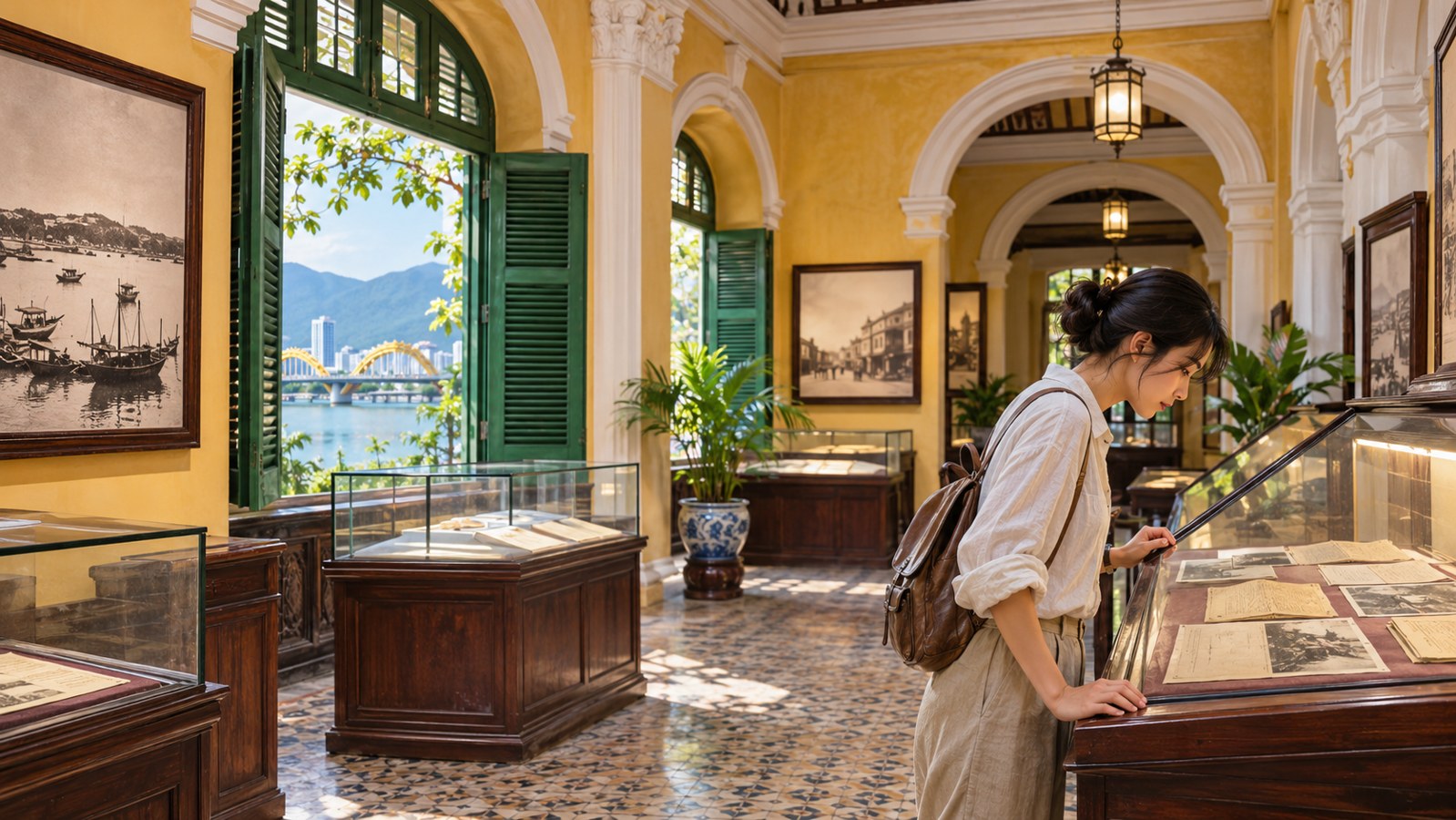
Go to 31 Trần Phú Street for the visitor entrance to Da Nang Museum's main history site. You may see it described by the historic former City Hall address at 42–44 Bạch Đằng Street, facing the Han River. These references describe the same museum complex, but use Tran Phu as your arrival point. The museum publishes daily hours of 08:00–17:00. Check the current notice for holiday changes, current admission and any display closures before going.
Allow around an hour for a focused visit or closer to 90 minutes if you want time for several themes. For a first visit, begin with the city and urban development displays, choose a historical or cultural theme you want to understand better, then finish with a smaller collection or exhibition. The former City Hall setting is part of the visit. A look at the building and its location makes the history of the city easier to connect with the streets and river outside.
Use the right museum entrance
| Name or address you see | What it refers to | Where to go |
|---|---|---|
| Da Nang Museum, main site | City history, local culture and collections | Visitor entrance at 31 Trần Phú |
| 42–44 Bạch Đằng | The riverside address associated with the former City Hall complex | Use the Tran Phu gate for normal visitor arrival |
| Da Nang Fine Arts Museum | The art museum in the wider city museum organisation | 78 Lê Duẩn |
| Museum of Cham Sculpture | A separate museum visit focused on Cham sculpture | Use its own entrance and admission information |
If you arrive by car, give the driver the full gate address. A pin on the river can leave you approaching from the building frontage rather than the visitor entry. For a walk from the Han River, check the route around the complex and follow the signed approach. If someone prefers to avoid extra crossings or a longer walk, make the entrance the primary meeting point. An arrival plan based on the door can be easier than meeting somewhere on the riverside and finding the gate as a group.
The museum's current institutional pages describe more than one location. If a driver, hotel desk or calendar entry only says “Da Nang Museum,” state that you mean the main history site at 31 Tran Phu. If the organiser is taking you to an art exhibition, check the exhibition address separately. The Da Nang Museum of Cham Sculpture guide covers another collection with its own purpose. Visitors interested in both can make them separate stops rather than treating the buildings as interconnected galleries.
Start with the building and the river
Before going deep into the exhibits, look at how the complex sits relative to the river and the surrounding streets. Da Nang's tourism information identifies the former City Hall as a historic part of the site. The building gives you a way into the exhibits: ask what an administrative centre needed from its location and what has changed in the streets around it. You can return to that question when you see city maps or historical photographs inside.
Once in the museum, look for an orientation plan. The museum describes three exhibition floors, with the first including antiquities, a children's area and periodic exhibitions. Its published themes also cover the city's nature and people, urban development, independence and conflict, contemporary development, the former City Hall and Quang regional culture. Use current gallery signs to find the particular section you want. Temporary installations and event areas can affect the order that makes sense on the day.
If you are visiting with a child or someone who wants a shorter route, choose one starting display and one stopping point before setting out. Ask about usable lift access and whether all the sections you want are on the same route. Visitors who would rather spend time sitting with a few labels should plan a shorter list than a group moving at a quick pace. An hour spent following two questions can be more useful than covering every floor without time to read.
A focused route for about an hour
First 10 minutes: orient yourself. At entry, work out where the museum explains Da Nang's setting and urban growth. Browse the gallery plan and ask staff if any sections on your list are temporarily unavailable. If an introductory view or photo wall is open, use it to identify one part of the modern city you recognise. Keep the question simple, such as how the river shaped the city or how the city changed as it grew beyond its earlier centre.
Next 20 minutes: follow the city story. Find a few photographs, maps or objects that help you compare the city across periods. Read the dates and captions as you go rather than assuming everything in a case is from the same moment. Look for the shoreline, bridges, buildings or infrastructure if the gallery brings them into view. For each object, ask what it was used for or what it shows about how people lived or worked. It is fine to walk past part of a display when it is outside the theme you chose.
Next 20 minutes: choose one historical or cultural theme. For a historical visit, spend the time with exhibits about the struggle for independence, the war or later development. Approach these as particular accounts and objects rather than trying to absorb every date. For a culture-focused visit, look instead at material connected with local communities and daily life. The displays may be more meaningful when you compare their use or material with something you have already seen around Da Nang. If a gallery has a strong introductory panel, start there before reading individual cases.
Last 10 minutes: finish with one small group or temporary display. Go to an area you can leave easily, especially if you have a ride or meal booked. The antiquities collection, a periodic exhibition or the children's area may suit different groups. Ask whether there is an event or activity on the day rather than assuming a listed area is running a session. Leave enough time to collect belongings and reach the Tran Phu entrance if the group is meeting outside.
Extend the visit when the galleries you want have time
For a 90-minute visit, give the city displays and the historical or cultural section 10 to 15 extra minutes each. Slow down at a few labels or compare two objects from different periods. This is also useful if the group has different interests. One person can read the stronger history section while another spends more time with the photographs or a separate exhibition. Set a meeting point at the end rather than having each person hurry to keep up.
When a display recounts conflict or loss, plan for people in the group to engage at their own pace. Reading a label and taking time with a small number of objects may be more appropriate than using every gallery as a photography stop. Check the museum's actual photography rules and follow directions near cases and documentary displays. For groups with children, allow a change of subject if a section is too intense for them. The site can be worthwhile even when visitors choose different parts to explore.
If you are interested in the steps between the historic building and its modern museum use, ask which displays cover the former City Hall. Then look at the building outside in the context of the city story. Think about what parts of the wider riverfront you can identify and whether you want to walk toward them afterward. The outing becomes more coherent when the outdoor part follows something you noticed inside, rather than making the museum a time filler between unrelated stops.
Make a useful connection with the city outside
After the museum, choose a short walk or meal based on the direction you want to go. You can head toward a stretch of central Bach Dang after using the appropriate crossing and current access. If you are interested in the bridges or evening activity, return to the same river context later in the day. The Dragon Bridge guide is helpful if that is your next specific outing rather than a point you need to reach directly from the museum.
A rainy-day visit can work with lunch or coffee nearby. Check the entrances and current conditions if you are moving on foot. During a heavy shower, a short ride to a named stop may make more sense than sticking to a long walk. Give your driver the pickup gate rather than the historic address if that is where you will wait. The Da Nang rainy-day activity guide has more options if you want to extend the indoor part of the day.
If you want to compare the history museum with the art museum, give each its own question. At the history site, follow the city, the river and local lives over time. At the art museum, pick works in different materials and look at how they handle the same theme differently. Both can fit a longer central visit, but allow time to travel between them and confirm the appropriate entry and ticket arrangements for each stop. The Da Nang Fine Arts Museum guide gives a separate one-hour route for the art collection.
Use the labels to connect objects to places
If you are taking the museum visit before exploring central Da Nang, make a note of one location mentioned in a display. Copy its Vietnamese name or street name where it appears. Once outside, use it as a reference for a later walk, while checking current access before visiting. A place can be important to the history of Da Nang without still looking like the image in the gallery. Comparing what survives with what has changed is often more interesting than trying to reproduce a historical photograph. This works especially well with an object, photograph or map that gives you a precise building, piece of infrastructure or stretch of river to look up.
Plan the practical details before you leave
Check current admission, accepted payment and any group or concession conditions before relying on an earlier price. Published opening hours help you choose a window, but if you arrive near closing, ask when last admission is possible. Bring enough time for the visit you want after passing the entrance. If a temporary exhibition or guided service is the deciding feature, confirm that it is operating on your date and in a language or format your group can use.
For a visitor requiring a particular access arrangement, ask about the door at 31 Tran Phu, the route to the desired gallery and level changes between sections. A building may have a useful accessible entrance while another part of the visit needs a different route. Request information for the particular floors you want to see. If a large group is visiting, agree on an entry plan and one meeting time, allowing individuals to spend time with different themes.
Save the address and turn the visit into one clear route: enter at Tran Phu, start with the city's context, spend your main block on one theme and leave time to return to the gate. That sequence works as a short visit while leaving you free to stay longer if an exhibition catches your interest.


