
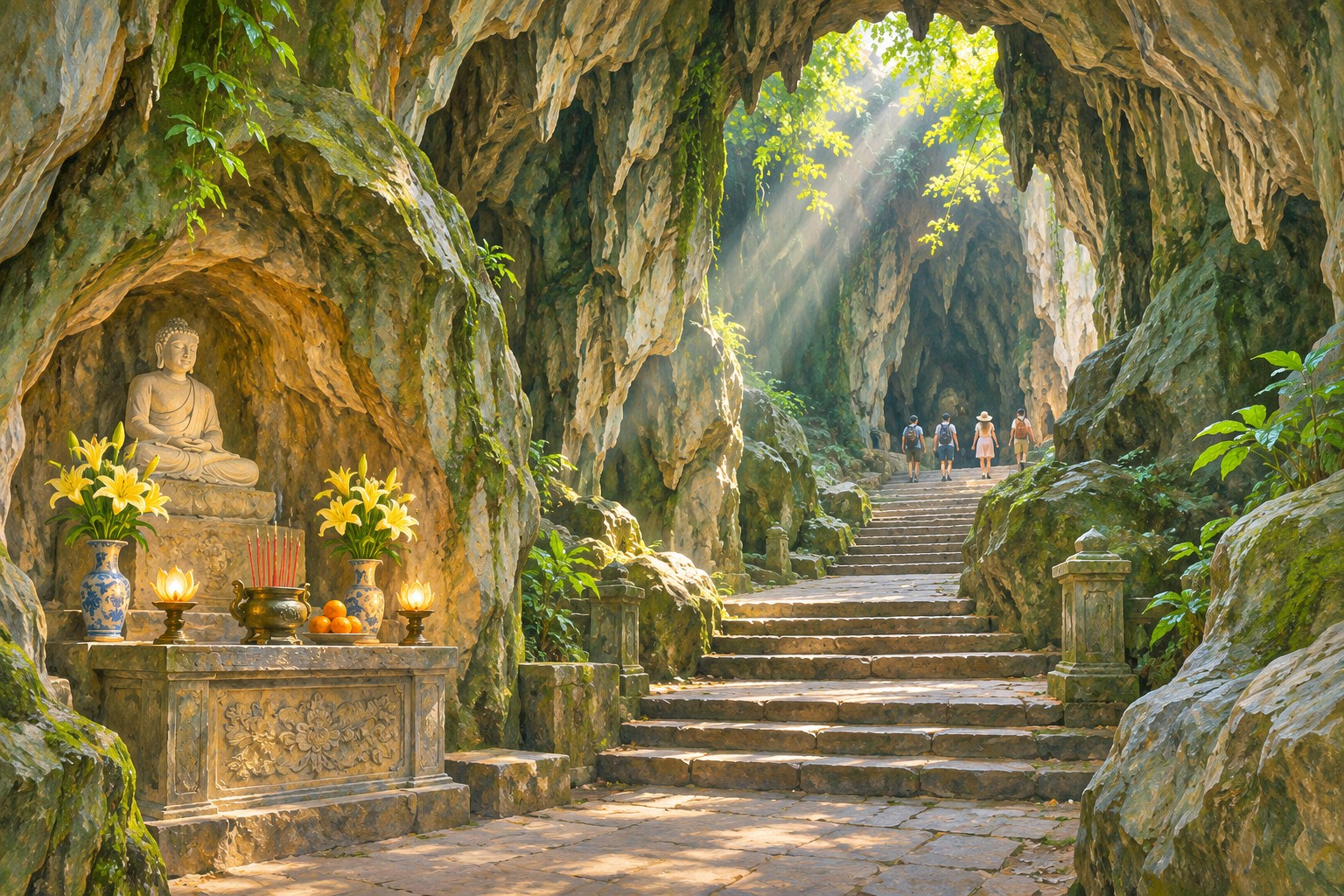
 The Marble Mountains are easier to appreciate when you think of the visit as a chosen walking route through a cultural landscape. The aim is not to climb every available staircase or collect every cave name. It is to explore a manageable selection with enough time to notice the spaces and understand what you are seeing.
This guide covers the decisions that shape that experience: which areas interest you, how to read the ticket options, what assisted access does and does not provide, and how to organize transport. It is especially useful for first-time visitors who want to enjoy the site without turning the outing into an endurance test.
What Are the Marble Mountains?
The name refers to a group of limestone and marble hills. Thuy Son is the main sightseeing focus for many visitors, with caves, pagodas, and viewpoints. The city tourism portal identifies Huyen Khong Cave, Tam Thai Pagoda, and Linh Ung Pagoda among the site's notable features.
There is also a Linh Ung Pagoda on Son Tra Peninsula. Make sure your map pin and driver refer to the location you intend to visit rather than relying on the pagoda name alone.
Tickets: Check What Your Purchase Covers
Review the current official information and on-site ticket board before paying. Admission, lift use, particular cave areas, or other services may have separate conditions.
Ask a clear question: “Does this ticket include the places on the route we want to visit?” Keep your ticket until you leave, and check any child eligibility or identification requirement before making assumptions about a discount.
This guide does not quote a permanent price because visitor categories and ticket arrangements can change. Use the amount displayed by the official seller for your travel date.
How Much Time Should You Allow?
Reserve a half-day in your itinerary, including transport, rather than allocating every minute to the site itself. Your visit can be shorter or longer depending on how much climbing, resting, and photography you want to do.
Choose a time that leaves you comfortable walking in the day's conditions. Check current opening hours, and avoid arriving close to the final entry if caves and viewpoints are important to you.
A Sensible Way to Explore
Begin by looking at the official site map. Identify the entrance, return route, toilets where available, and a few places you most want to see.
Then build a route with choices. A good plan might include one pagoda area, one cave, and a viewpoint that suits the group. Leave additional climbs as optional rather than obligatory.
At narrow steps, give people space and avoid stopping where you block movement. Put your phone away while negotiating uneven sections, then stop somewhere stable for photographs.
What the Lift Does and Does Not Solve
If a lift is available during your visit, ask which part of the site it serves. It should not be interpreted as a guarantee that every cave, path, or viewpoint is step-free.
Travelers with limited mobility should ask about the exact surfaces and remaining steps on their proposed route. A general description such as “easy access” is less helpful than a specific explanation of where a wheelchair, stroller, or walking aid can go.
Clothing and Footwear
Wear shoes with grip and bring drinking water. Choose clothing suitable for religious areas, including covered shoulders and knees where requested.
Carry a compact bag rather than shopping purchases that make stairs awkward. If you are visiting with children, keep the route modest and include breaks before anyone is exhausted.
Wet stone can change the difficulty of a route. Reassess your plan if conditions deteriorate rather than treating the original itinerary as a requirement.
Getting There and Leaving
Use the correct visitor entrance when booking a ride. If you arrange a waiting driver, confirm the meeting point, included waiting time, and contact method.
If you book a separate return ride, keep phone charge and data available. Do not depend on a last-minute pickup if you have a fixed onward departure.
Combining the Marble Mountains with travel toward Hoi An can make sense when the timing and luggage arrangements are clear. Avoid carrying bags around the site without a storage plan.
Choose a Route Around Interest and Mobility
Before buying tickets or beginning a climb, look at the current map and identify a few priorities. You may be interested in a cave interior, a pagoda, a viewpoint, or the stone-working tradition around the site. Those interests do not require the same route or amount of effort.
Ask which sections involve substantial steps, uneven surfaces, or narrow passages. The most useful question is not whether the mountains are easy, but whether your chosen route suits the people traveling with you. Someone comfortable with ordinary stairs may still prefer to avoid a longer steep section after a cave visit.
Build the route with an optional extension and a clear return. Begin with the places you most want to see, then decide whether to add more based on conditions and energy. That is more satisfying than reaching a final viewpoint because the itinerary says so and having little enthusiasm left to enjoy it.
Let the Caves Be Different Experiences
The city destination portal includes Huyen Khong and other caves among the site's highlights. Before entering a particular area, check whether it is included in your ticket and whether its route fits your group. A cave name on an attraction list does not establish its access conditions.
Take time to let your eyes adjust and notice the space rather than immediately searching for the photograph you have seen online. Observe the surfaces, light, and religious features without touching structures or disturbing worshippers. A brief pause can make the visit feel different from simply walking through a dark passage.
If a section feels unsuitable, turn back calmly and use another permitted route. There is no obligation to enter every interior. Travelers who prefer open spaces can still build an enjoyable visit around accessible religious areas and viewpoints they have confirmed.
Ask Better Accessibility Questions
Descriptions such as suitable for older people or accessible by lift are too broad to answer every visitor's needs. Ask about the route from the vehicle to the entrance, what the lift serves, the remaining steps, and where someone can comfortably rest.
If using a wheelchair, stroller, or walking aid, describe it accurately. Ask whether it can be used through the specific sections you want, whether assistance is needed, and where it would have to remain if a route becomes unsuitable. Do not make the decision solely from the presence of a lift in a photograph.
For a mixed-ability group, consider dividing the visit without separating anyone inconveniently. Some people may prefer a shorter route while others add a climb. Establish a safe, comfortable meeting arrangement and timing before doing so; do not leave the plan to be improvised at an unfamiliar junction.
Treat Religious Areas as Places with Their Own Purpose
The pagodas and shrines are more than scenery within a walking attraction. Bring suitable clothing and read instructions at individual entrances. Keep voices and behavior appropriate to the space and give people practicing their religion priority to move and pray.
You can observe respectfully without performing a ritual. If you want to understand a practice, ask an appropriate person or a knowledgeable guide rather than copying someone for a photograph. Avoid assuming that every object is available to handle or every interior is open for photography.
This approach also improves the experience for you. Slowing down and noticing how a space is used can reveal more than rushing between named sights. The route becomes a cultural visit rather than a sequence of visual backgrounds.
Decide Whether You Want Interpretation
A guide may be valuable if the history, architecture, and religious setting are your main interests. Ask about language, coverage, and time allocation. Confirm whether entry, transport, and guiding are included as separate parts of the booking.
If visiting independently, choose a smaller set of places and use reliable official information to understand them. Avoid inventing meaning from an unfamiliar statue or repeating a story simply because a short caption sounds convincing.
Transport-only arrangements can still work well. Just be clear that a waiting driver is not necessarily providing interpretation inside the site. Book the kind of support you want rather than expecting every service sold as a tour to include the same experience.
Combining the Visit with the Surrounding Day
For a straightforward morning, travel from your accommodation, explore a modest route, and return for lunch or rest. That gives the visit enough room without making it compete with another major outing.
If continuing toward Hoi An, confirm that the additional stop and waiting are included in the transfer. Establish where bags will be kept and what happens if your visit takes longer. A direct hotel transfer should not be treated as an unlimited sightseeing arrangement.
Keep the rest of the day suitable for how much walking you have done. If you chose an active route, a relaxed meal and easy evening can be a better continuation than another climb. If you shortened the visit, you can add a modest nearby experience without making it compulsory.
A Simple Decision at the Entrance
Use three questions before setting off: what do we most want to see, what route comfortably gets us there, and how do we return? Then check the ticket and current instructions against those answers.
If the answers change because of rain, mobility, or access, adjust the route before committing to a difficult section. The value of the visit does not depend on completing the most demanding path. It comes from choosing a route you can appreciate with enough attention and energy to enjoy it.
Frequently Asked Questions
Is the Marble Mountains visit suitable for everyone?
Suitability depends on the route, conditions, and mobility of the group. Confirm the actual access rather than assuming all areas are equally easy.
Can I visit with a stroller?
Ask about the specific accessible sections and remaining stairs. Have a practical alternative if the intended route does not accommodate it.
Do I need to see every cave?
No. Choose a few highlights that fit your energy and leave time to appreciate them.


