
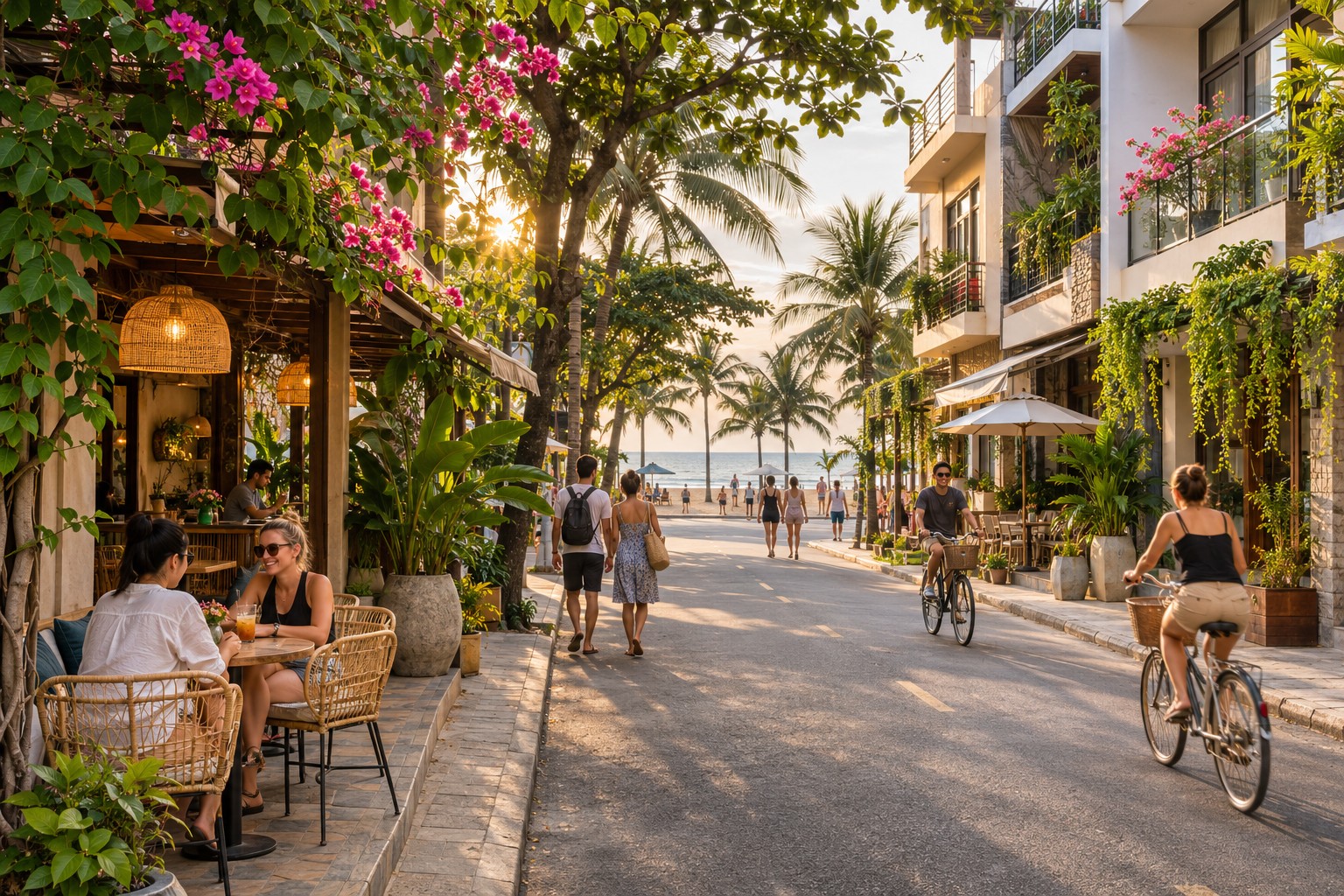
An Thuong Area Guide: Food, Cafes and Beach Life in Da Nang
An Thuong is useful because several parts of a beach holiday can happen close together. You can walk toward the coast, choose a cafe, find a casual meal and return to accommodation without making every small activity a separate journey. For many visitors, that convenience matters more than a single major attraction. The neighborhood works best as a base and a daily routine, not a place to rush through with a sightseeing checklist.
The exact street makes a difference. A room above a busy evening venue and a room on a quieter side street can produce very different stays under the same An Thuong label. This guide explains how to orient yourself, choose accommodation and enjoy the area while keeping the wider city within reach.
Understand the area through its connections
An Thuong is associated with the coastal neighborhoods near My Khe and My An. Streets around Hoang Ke Viem, Tran Bach Dang and the numbered An Thuong roads help provide orientation, but do not treat one informal boundary as a guarantee about every listing. Save the hotel's actual map pin and the entrance you will use.
Think in terms of the routes you repeat: room to breakfast, breakfast to the beach, dinner to the room. A location can look central within the neighborhood while being less convenient for your particular habits. Walk the practical route on the map and inspect crossings. A few extra minutes on foot may be worthwhile for a quieter building or a better room layout.
Build your first walk around the beach
Begin with a simple orientation loop rather than trying to identify every cafe. Find your easiest route to the coast, note a convenient crossing and locate a place to buy essentials. Return along a different nearby street so you start to recognize the blocks around your accommodation. Keep the first walk short enough that it remains enjoyable in the weather you find.
The beach is the reference point, but the neighborhood is not uniformly car-free. Do not assume that an area promoted as a tourist or pedestrian zone removes all vehicles from every surrounding road at all hours. Watch the current street conditions and keep your group together at crossings. Navigation becomes easier once you recognize the actual route rather than following the phone continuously.
Choose a cafe for the way you want to use it
A quick coffee, a long conversation and a work session require different places. Look at seating, noise, ventilation and whether the venue welcomes the length of visit you have in mind. A photogenic chair can be uncomfortable after twenty minutes, while a small counter may be ideal for a short stop.
If you plan to work, ask about the policy before occupying a table for hours. Order appropriately and respect busy periods. Test the connection before an important call, but do not assume a public cafe is a private office. For a quiet conversation, avoid choosing solely by the most popular social-media image. The setting should support the activity rather than make it harder.
Explore breakfast before committing to a routine
The neighborhood can support both Vietnamese breakfasts and more familiar cafe-style options, depending on the venue. Try a local noodle dish one morning and keep a simpler fallback for a day with an early departure. Check actual opening hours; a good dinner restaurant is not automatically a breakfast option.
Choose a place that fits the day's route. If you intend to visit downtown after breakfast, decide whether to eat nearby first or make the meal part of the city outing. Repeatedly crossing the city for small food stops can consume time without improving the experience. One satisfying nearby breakfast can be a better start than a complicated search for a supposedly essential address.
Use the food variety without losing the local context
A visitor-oriented neighborhood may offer Vietnamese food alongside several international styles. That can be useful during a longer stay or for a group with different preferences. It does not mean you need to choose between exploring local cuisine and enjoying a familiar meal. A comfortable balance is often what makes a trip sustainable.
Spread regional dishes across several days: mi Quang, bun cha ca, pork rice-paper rolls and banh xeo each provide a different meal. Ask about the restaurant's specialty rather than ordering from the longest menu. For current choices, compare menus and recent information near your own block. A useful neighborhood guide should help you decide, not freeze a changing restaurant scene into a permanent ranking.
Treat the night market as one possible evening
The city's tourism information describes an An Thuong night-market and pedestrian-zone experience. Check the current arrangement, operating days and active stalls locally rather than assuming every older photograph describes the same evening setup. Small markets and entertainment streets can change with weather, events and local management.
If you go, begin with a walk before ordering. Look at portions and current menus, then choose a modest amount. Keep room for another stop only if you still want it. A night market does not need to provide a complete dinner to be enjoyable; it can be a snack and an atmosphere visit before returning to a restaurant or your hotel.
Inspect accommodation at more than one time
A street that feels calm in the afternoon may become lively later. Before a longer booking, investigate nearby bars, rooftop venues and active construction. Ask the property which room orientation is quieter and whether your request can be guaranteed. A high floor is not a universal solution to sound.
For a short visit, recent room-specific reviews and direct questions are useful. For a month, a test stay can be even more valuable. Check the bed, curtains, air conditioning and desk as well as the neighborhood. Convenient restaurants cannot compensate for a room that makes sleep or work difficult every day. Choose the building and category, not just the area name.
Compare a hotel room with an apartment honestly
A hotel may simplify reception, cleaning and unusual arrival times. A serviced apartment may provide a kitchen, laundry or separate living space. Neither label establishes the complete arrangement. Ask what is included, who handles maintenance and whether utilities or cleaning are separate charges for a longer stay.
If you want to cook, inspect the equipment rather than relying on a photograph of a sink and microwave. If you work online, test the connection in the exact room. If you return late, confirm entry arrangements. These ordinary details make more difference over a week or month than decorative features that impress only on arrival.
Beach access deserves its own check
The neighborhood's proximity to the coast is a major advantage, but each hotel has a different route. Ask whether you cross the coastal road and which access point is most practical. For children or reduced mobility, inspect steps, pavement and crossings rather than relying on a short distance printed in a listing.
Follow beach flags and current local instructions when swimming. A nearby hotel or a convenient access point does not guarantee suitable water conditions. Keep a non-swimming plan available: a coastal walk, a cafe stop or another city activity can still make the day enjoyable. The benefit of staying close is flexibility, not an obligation to enter the sea regardless of conditions.
Use transport for the wider city deliberately
An Thuong is a base for part of Da Nang, not the whole city compressed into a few streets. The riverfront, museums, Son Tra and northwest-coast places require their own routes. Group outings by direction so you spend more time at destinations and less time returning through the same traffic.
Set a clear pickup pin where a vehicle can reasonably stop. A building entrance on a narrow or busy street may not be the best meeting point. Confirm the destination before departing and save your accommodation address for the return. A little preparation is particularly useful in the evening when several nearby businesses may have similar-looking signs.
Plan for rain without treating it as a lost day
A neighborhood with nearby meals and cafes can be comfortable during unsettled weather, but walking still requires attention to puddles, slippery surfaces and available shelter. Keep an indoor option that does not depend on occupying a cafe table indefinitely. A museum outing or a cooking class can give the day a different focus.
Accommodation matters more when you spend additional hours inside. Ask whether there is somewhere comfortable to sit besides the bed, and consider drying space for clothing. A room with a useful layout can make a mixed-weather stay pleasant. Do not choose only for a balcony photograph if the indoor space is too cramped for the way you travel.
Respect the neighborhood beyond the visitor businesses
People live and work around the hotels, restaurants and entertainment venues. Keep voices reasonable near residences, avoid blocking entrances and ask before taking close photographs of people. A lively holiday atmosphere does not remove the need to notice ordinary neighborhood boundaries.
Support businesses through clear orders and considerate use of space. If you are working in a cafe, understand its expectations; if you are visiting a small food stall, let service continue while you decide. These small habits help the area remain enjoyable without treating every local interaction as a performance arranged for travelers.
A simple two-day introduction
On the first day, orient yourself between your accommodation and the beach, choose an easy lunch and return for a rest before exploring dinner options. On the second, try a different breakfast, make one wider-city outing and come back for a relaxed evening. This gives you both a neighborhood routine and a sense of the rest of Da Nang.
After that, keep what works. A favorite coffee stop or reliable meal can become an anchor rather than a failure to explore. Use the My Khe Beach guide, the month-long accommodation guide and the Vietnamese breakfast article to refine the routine. An Thuong is most rewarding when its convenience gives you more freedom, not when it becomes another area you feel obliged to exhaust in one visit.


